The Engineering Mindset Behind Our System
Before Thrivr, I was a propulsion design engineer at Boeing. I worked on the nacelle, the nozzle, the skins, the longerons, the support structure and the fire seals, down to the riveting, manufacturing processes and geometric tolerancing.
My job was to be the quarterback for all the engineers touching my parts: fire, aero, stress, weights and manufacturing. Each one handed me boundary conditions and constraints. I had to weigh all of it, make the best decision and move forward. The goal was always the same: build a system that works for the end goal, which was a plane that flies.
That's exactly how we run ads. The product is different. Ours is conversions, clients and new customers. But you still get lots of opinions and there's no single perfect path. You make the most informed decision you can with the data you have, move forward, and make a better decision next time when you have more data. You can read more about my background on our founder page.
Step 1: Onboarding
Every client starts by completing a detailed onboarding document. It takes about 30 minutes, and we don't let clients use AI to fill it out, because we need their real answers. It covers:
- Their best performing offers and the offers they want to test
- The products and services they want to push
- Their most profitable jobs
- How long jobs take to run and complete
- What the permitting process looks like
- What makes them unique
- How many years they've been in business
Then every client gets their own client portal. We either integrate with their existing CRM or build one for them, and we include a free website with every build.
Next comes an onboarding session where we sit down and talk through the campaigns and ads together, so we understand the business and the client is happy with the direction before anything is filmed.
Step 2: Shoot Day
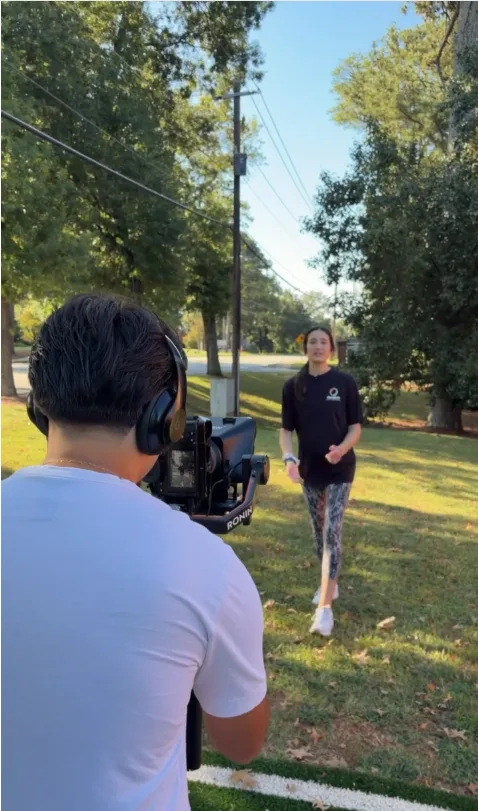
Once the filming date is locked, I come out with my videographer and a teleprompter. We start early to get the best sun.
Over four to five hours, we film everything:
- A roll: the scripted ads, with the teleprompter mounted on a gimbal
- B roll: crews on site working a job, either a completed project or one in progress
- Short snippets for social posts
- Photos and footage for the website
We work through the scripts together on site and figure out what works in the moment. One shoot day usually gives us about 15 ads, plus enough content for the website and social media. For more on scripting, read how to write a Facebook ad for a home services business.
Step 3: Editing
After the shoot, our editors take the handoff. Editing usually takes three to four days. They focus on everything that keeps people watching:
- Timing and beats
- Cuts and removing dead space
- The look of the footage
- Captions
- Sound
On social media, people can scroll away at any second. Every frame has to earn the next one.
Step 4: Launch
We usually launch with about three videos. From there, a new campaign goes out every few weeks depending on performance. If you're setting up campaigns yourself, start with how to set up your first Meta ad campaign.
How We Structure Campaigns
We run two campaigns: Launch and Scale.
- Launch is where new creative is tested to find the winner.
- Scale is where a proven winner gets more budget.
The key rule: we never touch a winning campaign. Editing a winner can reset it to the learning phase. So when a winner emerges, we leave it running, and the two campaigns swap roles. That way, nothing ever has to reset.
We're always competing for first place. There's always a split test running somewhere in the account, so the winner keeps winning until something new beats it.
How We Pick a Winner
Most of the time, we let Facebook decide. It's very good at spotting which ad performs best. Often there's more than one winner in a campaign, so we duplicate the campaign and take the top winner out to see which of the others also perform.
When We Retire an Ad
We watch frequency, CPM and cost per lead. When frequency climbs and costs creep up, the ad is fatigued and it's time for fresh creative. Some ads last months, others a few weeks. More on this in why your Meta ads aren't working.
Targeting: Broad Wins Right Now
Broad targeting works best today. Meta reads your creative and finds the right buyers on its own. We lock the location and leave interests broad.
- Retargeting: we use the Meta pixel to show testimonials to people who already watched our ads, clicked through or became leads. The goal is to turn warm interest into booked appointments.
- Lookalike audiences: they work, but we don't lean on them heavily. Most Georgia home service businesses aren't at the scale where they make a big difference.
Tracking: What We Set Up
- The Meta pixel on the client's website
- The Conversions API, which sends data from the CRM back to Meta
- A CRM sync, so each pipeline stage (booked, proposal sent, closed) is sent back to Meta automatically
That tells Meta which leads became real customers, so it can find more of them. For the full pipeline, read what's a good ROI for Meta ads.
A Cheat Code: Put Winning Ad Copy on Your Website
When an ad wins, take its copy and put it on your website. The message that got homeowners to stop scrolling will also convert them on your site.
The Weekly Call
Every week we meet with the client and walk through:
- Lead quality. Do we add friction, like more qualifying questions or phone verification, to get higher intent leads? Or remove friction to get more volume?
- Cost per lead
- Cost per booked appointment
- Customer acquisition cost
Clients send us back their leads, booked calls and closed deals. The goal is simple: a healthy pipeline and a business that's growing and scaling.
What the Client Does
Give us access to everything, then focus on closing deals and doing great work. We handle the marketing, creative, automations and CRM. Your side of the fence is calling leads fast and closing them. Here's why Facebook leads go cold when that call doesn't happen.
A Full Client Story: Elite Retrofits
Josh Fuller owns Elite Retrofits, which sells motorized screens, motorized awnings, shades and umbrellas. He was looking at other agencies when he brought us in. They had never run ads before. We were the first company they worked with.
Their first campaign took off. We moved the business from referral based to something scalable, predictable and repeatable, and we kept their cost per lead low throughout the year.
Over 90 days, the campaign produced:
- 319 leads
- $13.60 per lead
- $4,337 in total spend
Josh was so happy that he brought us in for his second company, A Filmz, a signage and tinting business, and we did the same thing there. See the full breakdown in our case studies.
What You Should Have by Day 90
By day 90, you should have a scalable, repeatable system. You should know your customer acquisition cost, your cost per booked appointment and the numbers you need to take your business to the next stage. Here's how long it really takes to see results.
The System, Summed Up
- Onboard deeply so the ads reflect what makes the business unique.
- Film real video on your job sites.
- Edit for attention, second by second.
- Launch, test constantly and never touch a winner.
- Keep targeting broad and feed pipeline data back to Meta.
- Review lead quality and acquisition costs every week.
- Call every lead fast and close.
If you're still deciding, read should I hire a Facebook ads manager or run ads myself.
Want us to run this system for your business? See how our system works, check our results, run your numbers in Lead Math, or book a call.
Book a callFrequently Asked Questions
How do you run Meta ads that actually work for a home service business?
With a system: deep onboarding, real video filmed on your job sites, constant testing, fast follow up and a pipeline that feeds data back to Meta. Settings and targeting matter less than the system around them.
How long is a Thrivr shoot day?
Four to five hours. We film the scripted ads on a teleprompter, B roll of crews on site, snippets for social and photos for the website. One shoot day usually gives us about 15 ads.
How do you structure Meta ad campaigns?
Two campaigns: Launch, where new creative is tested, and Scale, where a proven winner gets more budget. We never edit a winning campaign, because that can reset it to the learning phase.
Should contractors use broad targeting or lookalike audiences?
Broad targeting works best today: lock the location and leave interests broad. Lookalikes work, but most Georgia home service businesses aren't at the scale where they make a big difference. Use pixel retargeting to show testimonials to warm audiences.
What tracking do Meta ads need?
The Meta pixel on your website, the Conversions API and a CRM sync that sends each pipeline stage (booked, proposal sent, closed) back to Meta so it can find more real customers.
What should I have after 90 days of Meta ads?
A scalable, repeatable system, and clear numbers: your customer acquisition cost, your cost per booked appointment and what you need to reach the next stage.